Understand calculated expenditure
See how food intake and weight history inform an energy estimate.
How to use it
- Log food consistently and add regular weigh-ins.
- Open Progress → Nutrition and review Expenditure Over Time.
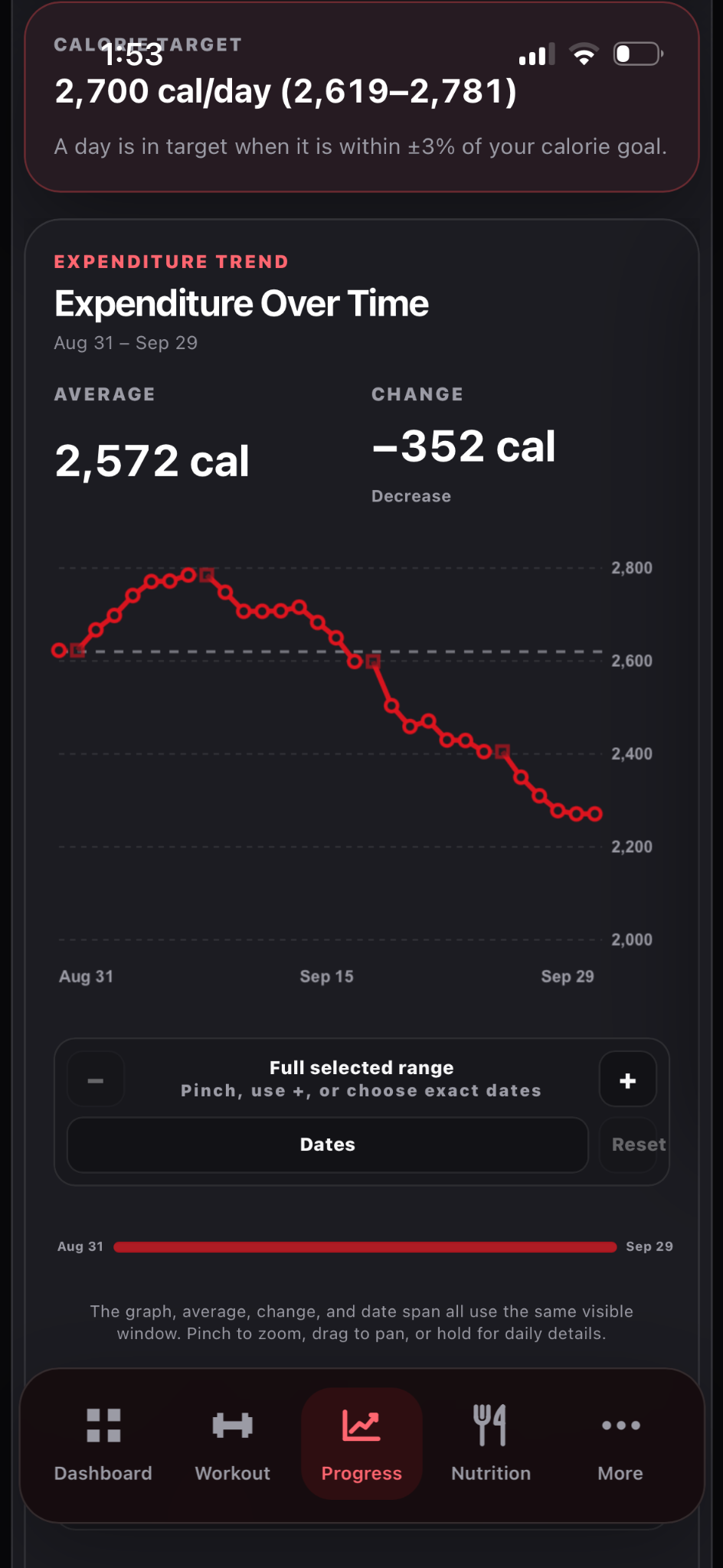
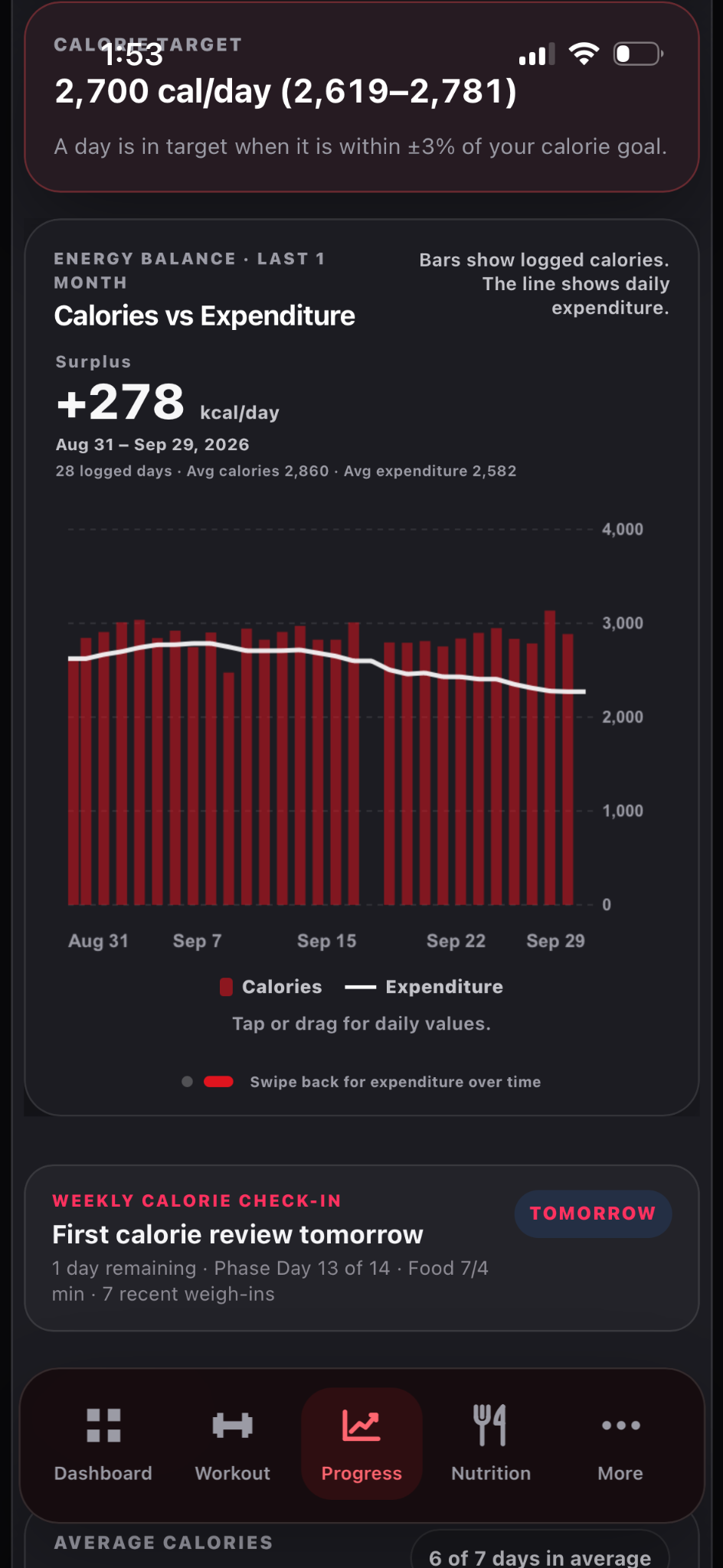
- On Expenditure Over Time, compare the average and change across the selected date window. Swipe to Calories vs Expenditure to see logged intake against the estimate.
- Use the weekly review when enough data is available.
How Level Up calculates it
Calculated expenditure is an estimate of the calories you burn per day, inferred from two observations: how much you log eating and how your body-weight trend changes. It is not a direct metabolic measurement.
- Average logged intake: Level Up looks at the 21 days through yesterday and averages calories on days with food entries. Today is left out while it is still in progress. Unlogged days are not counted as zero.
- Weight direction: It uses your smoothed Trend Weight, drawing on up to about 20 days of measurements, to estimate a change in pounds per week. Smoothing reduces the effect of an unusually high or low weigh-in.
- Energy balance: The app converts that weekly change into an approximate daily energy difference, then subtracts it from average intake. In simple terms, estimated expenditure = average logged calories − (weekly weight change × approximately 3,500 ÷ 7). A gain makes the estimate lower than intake; a loss makes it higher.
For example, if you average 2,800 calories a day and your trend rises 0.4 lb per week, the estimated expenditure is about 2,600 calories a day. If the trend instead falls 0.4 lb per week, it is about 3,000. These numbers illustrate the calculation; they are not a calorie target.
The energy value defaults to 3,500 calories per pound. When a body-fat estimate is available, Level Up blends in a small body-composition adjustment and keeps the value within a narrow range. This is a practical approximation: the energy content of weight change varies by person and over time.
When the estimate becomes reliable
The first estimate requires at least two logged food days and three weigh-ins spanning five days. “Building confidence” requires seven food days and six weigh-ins spanning ten days. “High confidence” requires 15 food days and nine weigh-ins spanning 17 days. More complete logs and regular weigh-ins make the result easier to interpret; missed food entries can make expenditure look too low.
The live chart can update as new completed days arrive. The weekly reviewed estimate changes on a seven-day cadence when there is enough data; during the building stage it moves by at most 50 calories per day per review, or 100 at high confidence. The chart can hold the last usable daily estimate when a new one cannot be calculated. A flat segment can therefore mean “holding,” not proof that expenditure is constant.
How to interpret it
This is an estimate from observed intake and body-weight changes, not a direct measurement of metabolism. Short-term water and gut-content shifts can distort the signal; interpret multiweek trends.
The two expenditure views